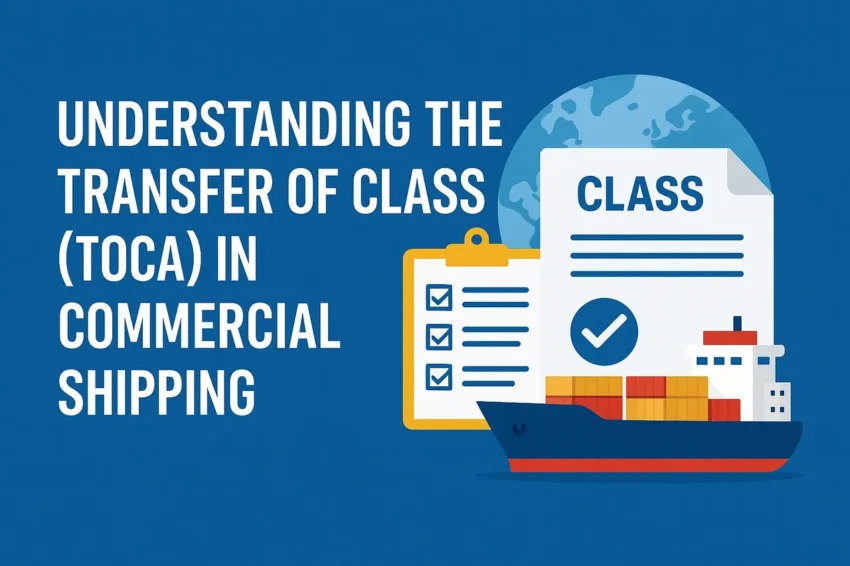
In the dynamic world of commercial shipping, it’s not uncommon for vessel owners to consider changing the classification society of a vessel—a process known as Transfer of Class (TOCA). While it might seem straightforward for newer ships that have been consistently maintained under class, the process can become more complex depending on various factors, such as the vessel’s age, construction background, or current class status.
Let’s break down the key scenarios, procedural guidelines, and survey requirements associated with transferring class, to help shipowners, managers, and operators navigate this process more confidently.
When and How a Vessel Enters Class
A vessel can obtain classification certification under two main circumstances:
1. Newbuild Supervised by an IACS Class Society
A ship built under the supervision of a classification society that is part of the International Association of Classification Societies (IACS) will be issued a certificate of class after:
- Approval of construction plans and documentation.
- Evaluation of materials and equipment, sometimes including inspections at the manufacturer’s premises.
- Surveys ensuring compliance with approved construction standards.
- Successful tests and trials, including sea trials and inclining experiments.
2. Existing Vessel Entering Class While In Service
Alternatively, a vessel can enter or transfer into a class society while already in operation. This often involves:
- Changing from one IACS class society to another.
- Re-entering class after a previous IACS class certificate was withdrawn.
- Entering an IACS class for the first time, having been built under non-IACS rules or without class at all.
Applicable Guidelines for Class Transfer
To standardize the process, IACS has issued specific procedural requirements:
- PR 1A – For vessels transferring from one IACS member to another.
- PR 1B – For vessels adding a second IACS classification while maintaining an existing one.
- PR 1D – For vessels not built under IACS class rules or coming from non-IACS classification.
General Approach Behind These Procedures:
a) Non-IACS or Unclassed Vessels Entering IACS Class
These vessels undergo a comprehensive evaluation, including:
- Review of structural drawings against IACS rules.
- Drydock inspection.
- Full initial survey, including internal inspections of tanks, tail shaft, propellers, etc.
b) Vessels with Withdrawn IACS Class
If a vessel was built under IACS supervision but currently lacks a valid class certificate:
- Original approved plans may be accepted.
- A renewal survey is typically required, including hull thickness gauging and complete drydock inspection.
c) IACS to IACS Class Transfer
When transferring between IACS societies, the age of the vessel determines the survey scope:
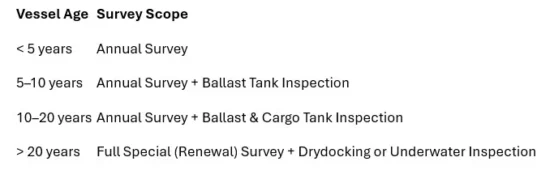
Full Special (Renewal) Survey + Drydocking or Underwater Inspection
Note: Any existing Conditions of Class (COC) or overdue surveys must be cleared by the outgoing class society before transfer, especially for vessels over 20 years old.
Special Cases – ESP Notation
Vessels over 15 years of age with ESP (Enhanced Survey Program) notation may require an intermediate or renewal survey, depending on what’s due next, along with drydocking or equivalent underwater inspections.
Conclusion
The process of transferring class is more than just administrative—it’s a technically detailed and survey-intensive procedure that varies depending on the vessel’s age, maintenance history, and prior classification. Whether you’re entering class for the first time or moving between IACS societies, understanding the survey scope, documentation requirements, and procedural framework (PR 1A, 1B, 1D) is essential for a smooth transition.
Each case must be evaluated individually, considering factors like cost, downtime, and operational impact.
Frequently Asked Questions (FAQ)
1. Can I switch class societies while my vessel is trading?
Yes, but the process requires coordination to ensure surveys and certifications are aligned. Some inspections may need to occur during a planned drydocking.
2. How long does a class transfer usually take?
Depending on the vessel’s condition and age, it can take anywhere from a few days to a few weeks—especially if drydocking and repairs are required.
3. What documents are required for a class transfer?
Typical documents include:
- Structural drawings
- Previous class certificates
- Survey reports
- Maintenance and repair history
- Equipment certifications
4. What happens to outstanding deficiencies or COC during a class transfer?
For ships with age above 20 years, all pending COC must be addressed and cleared by the existing class society before the new class accepts the vessel.
For ships below age of 20 years, the pending COC can be transferred & handled by new clas society,
5. Is it cost-effective to change class for older vessels?
For vessels over 20 years, costs may increase significantly due to the extensive survey requirements. A cost-benefit analysis is advisable before proceeding.
Ready to Navigate a Class Transfer?
At Optimum Marine Consulting, we help vessel owners and managers evaluate class transfer options, manage documentation, and liaise with class societies to ensure a seamless transition. Whether you’re considering a transfer or need support understanding PR 1A, 1B, or 1D procedures – we’re here to help.
👉 Contact us today to schedule a consultation and ensure your next class change is smooth, compliant, and cost-effective.