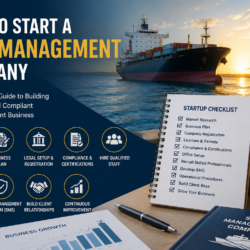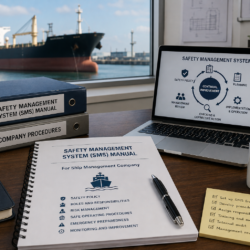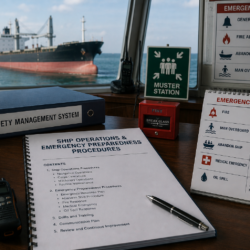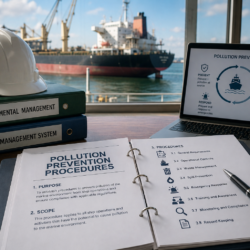
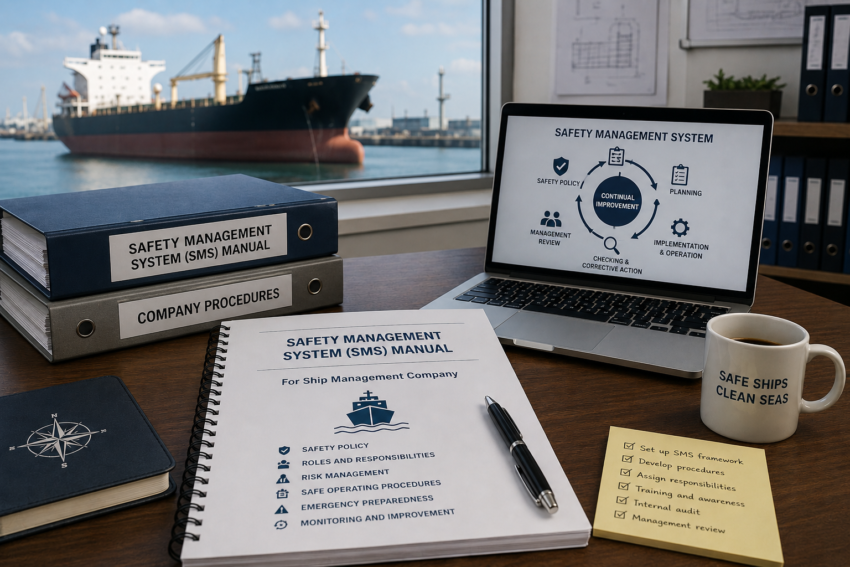
Compiling a Safety Management System (SMS) Manual is one of the most crucial foundational steps in launching a successful ship management company. The ISM Code acknowledges that no two companies are exactly alike — each has unique operational needs, organizational structures, and ship profiles. That’s why a tailor-made approach to your SMS manual is essential.
In this article, we highlight key elements of the ISM Code and practical pointers you can use when developing your SMS manual. These insights serve as a structured reference to help you ensure that your system complies with regulations and supports operational excellence.
ELEMENT 1: General Definitions & Objectives
Start by clearly defining the terminology used in your SMS (e.g., DOC, SMS, SMC, non-conformity, audit, objective evidence). Then, outline your SMS objectives:
- Ensure the safety of life, property, and the marine environment
- Prevent injuries and loss of life
- Promote safe practices and a secure working environment
- Identify and mitigate risks
- Establish emergency preparedness
- Drive continuous improvement
- Comply with applicable regulations, codes, and standards
ELEMENT 2: Company Policies
A robust SMS should include a comprehensive set of company policies. These should reflect the values, mission, and compliance objectives of your organization:
- Mission & Vision Statements
- Management Commitment Policy
- Safety Policy
- Quality Policy
- Environmental Policy
- Health & Hygiene Policy
- Drug & Alcohol Policy
- Energy Efficiency Management Policy
- Code of Ethics & Conduct
- Cybersecurity Policy
ELEMENT 3: Responsibility & Authority
This section should define the organizational structure both ashore and onboard, and clearly outline the responsibilities of all personnel:
- Organizational charts (shore and shipboard)
- Roles, responsibilities, qualifications, and reporting lines
- Statement of management’s commitment to supporting shipboard operations
ELEMENT 4: Designated Person Ashore (DPA)
The DPA is a vital link between ship and shore. Your SMS must define:
- Appointment of the DPA and their direct access to top management
- Oversight of safety and environmental activities
- Monitoring and support for ship operations
- Review and implementation of corrective actions
- Continual improvement and review of the SMS
ELEMENT 5: Master’s Responsibility & Authority
The Master holds overriding authority for safety and environmental matters. The SMS should include:
- Statement of the Master’s ultimate authority
- Implementation and enforcement of SMS onboard
- Crew motivation and guidance
- SMS reviews and feedback to shore-based management
ELEMENT 6: Resources & Personnel
Your SMS must establish procedures to ensure adequate staffing and crew competency:
- Seafarer selection, certification, and manning procedures (STCW compliance)
- Onboard familiarization processes
- Training and continuous professional development
- Establishment of working language
- Communication procedures for SMS updates and compliance
ELEMENT 9: Reporting & Analysis of Non-Conformities, Accidents, and Near Misses
Ensure your SMS includes:
- Detailed procedures and forms for incident reporting
- Guidelines for immediate corrective actions and root cause analysis
- Preventive action planning and follow-up
- Documentation and evidence tracking
- Review processes for continuous improvement
FLAG-SPECIFIC INSTRUCTIONS
Since the Document of Compliance (DOC) and Safety Management Certificate (SMC) are issued by or on behalf of Flag States, it’s critical to integrate flag-specific requirements:
- Include Marine Notices and operational instructions issued by relevant Flag Administrations (e.g., Panama, Liberia)
- Ensure compliance with all statutory and regulatory guidelines as mandated by the chosen flags
ENVIRONMENTAL PROTECTION
Pollution prevention is a core goal of the ISM Code. We recommend developing a dedicated Environmental Management Manual — either integrated with the SMS or as a standalone document — to comprehensively address this requirement.
CYBERSECURITY
As digital threats rise in the maritime sector, it is imperative to incorporate a cybersecurity strategy into your SMS:
- Address cyber risk management, data protection, and resilience
- Align with current IMO guidelines and industry best practices
Note: Elements such as Shipboard Operations (Element 7), Emergency Preparedness (Element 8), Ship Maintenance (Element 10), Documentation Control (Element 11), and Review & Evaluation (Element 12) have been explored in a subsequent Article, as these require in-depth guidance due to their operational complexity.
Frequently Asked Questions (FAQ)
Developing a Safety Management System (SMS) Manual for Ship Management Startups
1. What is an SMS Manual, and why is it essential?
An SMS (Safety Management System) Manual is a structured document required under the ISM Code. It outlines policies, procedures, responsibilities, and controls to ensure the safety of ships, personnel, and the environment. It is essential because it forms the foundation for obtaining ISM certification and enables consistent, compliant, and safe ship operations.
2. Is a generic SMS manual enough for my company?
No. The ISM Code requires each SMS to be tailored to the unique organizational structure and operational profile of the company and the types of ships managed. A one-size-fits-all approach often leads to non-conformities and operational risks.
3. What is the role of the Designated Person Ashore (DPA) in the SMS?
The DPA acts as a direct link between ship and shore. Their role includes monitoring safety and pollution prevention, supporting vessel operations, managing internal audits, and ensuring compliance with the ISM Code.
4. Do I need a separate Environmental Management Manual?
While not mandatory, we strongly recommend either integrating environmental protection into your SMS or developing a standalone Environmental Management Manual. This improves clarity and strengthens your pollution prevention strategy, aligning with ISM objectives.
5. How often should the SMS manual be reviewed or updated?
Regular reviews are required — at least annually or whenever significant operational changes occur. Updates should also reflect changes in regulations, industry standards, or internal audit findings.
6. What flag-specific requirements must be included?
The SMS must include instructions, circulars, or notices issued by the Flag State(s) under which your ships are registered. These could include operational procedures, safety protocols, or inspection requirements specific to that administration (e.g., Panama, Liberia).
7. How long does it take to compile a compliant SMS manual?
Timelines vary depending on company complexity and readiness. Typically, with proper guidance, an initial SMS manual can be prepared and submitted for review within 4–6 weeks.
8. Can Optimum Marine Consulting assist with ISM audits and DOC certification?
Absolutely. We offer end-to-end support — from drafting your SMS manual to preparing for ISM audits, liaising with classification societies, and guiding you through the interim and full DOC certification processes.
9. Do you provide ongoing support after SMS implementation?
Yes. We offer continuous support for system updates, crew training, internal audits, and compliance checks – ensuring your SMS evolves with your operations and regulatory changes.
⚓ Ready to Launch Your Ship Management Company the Right Way?
At Optimum Marine Consulting, we specialize in guiding startups through the complexities of Safety Management System (SMS) development and ISM compliance — ensuring you’re not just operational, but confidently audit-ready.
✅Custom-Built SMS Manuals
✅End-to-End Support for DOC Certification
✅Flag-Specific Compliance Guidance
✅Cybersecurity & Environmental Strategy Integration
Don’t leave your compliance to chance. Let’s build a safer, smarter future for your fleet together.
📞 Schedule a Free Consultation Today