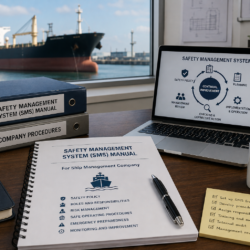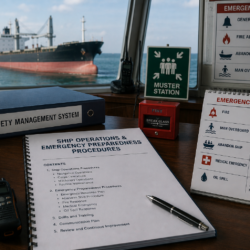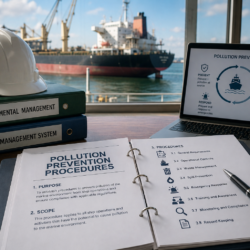
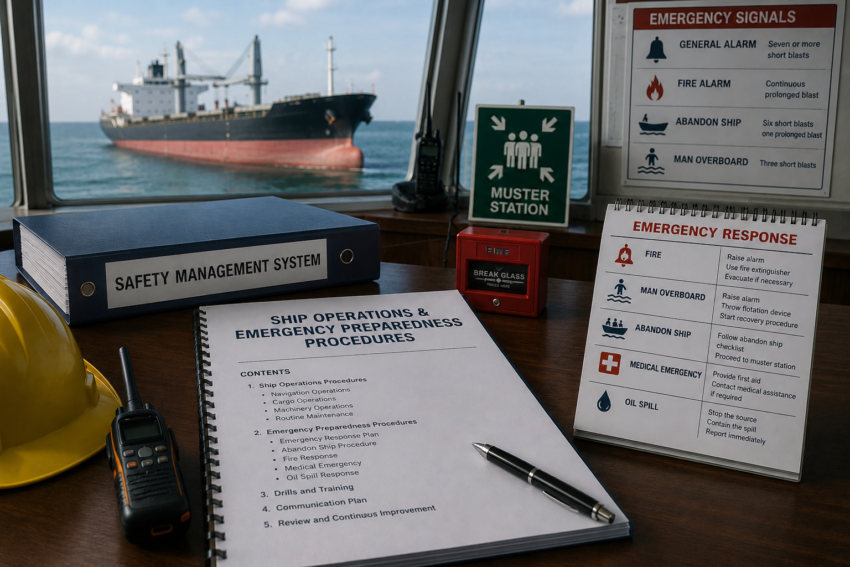
A well-structured and practical Safety Management System (SMS) forms the backbone of any effective ship management operation. The operational requirements of the SMS are supported by Three essential pillars of this system:
- Shipboard Operational Procedures
- Emergency Preparedness Plans
- A Robust Maintenance Program
In this article, we provide a clear and concise guide for compiling your SMS manual in alignment with the ISM Code, focusing on Elements 7, 8, and 10.
ELEMENT 7 – PLANS FOR SHIPBOARD OPERATIONS
To operate safely and prevent pollution, companies must establish documented plans, checklists, and responsibilities for all critical shipboard operations. These should be aligned with the ship’s operational profile and manned by competent personnel.
Key Operational Areas Include:
- General Safety Procedures
- Bridge Navigation Operations
- Deck and Mooring Operations
- Engine Room Procedures
- Cargo Handling
- Firefighting and Survival Equipment Use
- Oil Pollution Prevention
Identifying Critical Operations:
Any activity where a misstep could lead to an accident or pollution incident must be classified as a critical operation. Examples include:
- Navigation in restricted or congested waters
- Handling dangerous goods
- Bunkering and ship-to-ship (STS) transfers
- Enclosed space entries
For each critical operation, a formal Risk Assessment must be conducted and included in the SMS
Navigation Procedures (Sample Inclusions)
- Navigation in various conditions (e.g., TSS, heavy weather, ice)
- Pre-arrival and departure procedures
- Use of tugs and pilots
- Updating charts/publications
- Emergency communication protocols
Deck & Engine Room Operations
Deck:
- Watchkeeping protocols
- Mooring and anchoring
- Safe use of pilot and accommodation ladders
Engine Room:
- Operating main and auxiliary machinery
- Port/voyage watchkeeping
- Fuel, lube oil, pollution prevention systems
Cargo Operations
- Tank/Hold prep and inspection
- Loading/discharge procedures
- Cargo care during passage
- Ballast handling
- Equipment use (cranes, pumps)
Permit-to-Work System
The SMS must include a detailed permit-to-work system, covering:
- Enclosed space entry
- Hot work
- Electrical isolation
- Work aloft or overside
- Underwater inspections
- PPE Matrix
Also include procedures for crew health, hygiene, fatigue, and drug/alcohol policies.
ELEMENT 8 – EMERGENCY PREPAREDNESS
An effective SMS anticipates emergency situations and prepares both crew and shore staff to respond effectively.
Potential Emergency Scenarios:
- Collision or grounding
- Fire, explosion, or flooding
- Pollution incidents
- Mechanical or electrical failures
- Piracy, terrorism, or man overboard
- Abandon ship or major health emergencies
The Emergency Plans Should Include:
- Designated Emergency Response Teams
- Clear initial action protocols
- Communication and reporting channels
- Ship-specific annexes (GA plans, piping diagrams, etc.)
Company Contingency Manual:
This ensures company-level coordination during shipboard emergencies, supporting onboard teams and external stakeholders.
Training & Drills:
Emergency drills must be realistic, aligned with regulatory requirements, and properly documented – ideally with photos and evaluation notes.
ELEMENT 10 – MAINTENANCE OF SHIP & EQUIPMENT
This element ensures the vessel and all equipment are maintained in line with class rules, regulations, and company standards.
Planned Maintenance System (PMS):
A digital PMS is the preferred method for streamlining maintenance across multiple vessels. For startups, spreadsheet-based systems may be sufficient initially but should evolve as the fleet grows.
Key Features of an Effective PMS:
- Scheduled maintenance based on manufacturer recommendations
- Task allocation to crew per SMS responsibilities
- Record-keeping of inspections and servicing
- Breakdown history, corrective actions, and documentation
Note:
Some ships may carry an additional class notation “PMS.” If so, the implemented software must be approved by an IACS classification society.
Conclusion
The successful implementation of a Safety Management System (SMS) hinges on the seamless integration of three core pillars: clearly defined shipboard operational procedures, robust emergency preparedness, and a reliable maintenance framework. Each component is not only a regulatory requirement under the ISM Code but also a practical necessity for ensuring the safety of the crew, the vessel, the cargo, and the environment.
By addressing the operational realities of your fleet and embedding proactive safety and maintenance strategies, ship management companies can build a culture of continuous improvement and operational resilience.
Frequently Asked Questions (FAQ)
1. What is the ISM Code and why is it important for ship management companies?
The ISM Code (International Safety Management Code) is a global standard that ensures safety at sea, prevention of human injury or loss of life, and avoidance of damage to the marine environment. Compliance is mandatory for most commercial vessels and is essential for legal operation and credibility.
2. Can a startup ship management company use a ready-made SMS template?
While templates can be a starting point, SMS manuals must be tailored to a company’s specific operational profile, organizational structure, and the types of vessels managed. Optimum Marine Consulting offers customized SMS solutions to meet these requirements.
3. How often should emergency drills be conducted?
Drills should be conducted regularly as per SOLAS and flag-state requirements. The SMS should outline a structured drill schedule to maintain crew readiness and compliance.
4. Do we need SMS approval from the Flag State or Classification Society?
Yes, the SMS must be reviewed and approved as part of the Document of Compliance (DOC) issuance process, typically carried out by a Classification Society or an authorized Recognized Organization (RO).
5. What is a Planned Maintenance System (PMS) and why is it important?
A PMS ensures that machinery and critical equipment are regularly maintained to prevent failures. It enhances safety, ensures compliance, and contributes to vessel efficiency. PMS software is highly recommended for scalability and automation.
6. Can Optimum Marine Consulting assist in selecting PMS software?
Absolutely. We help evaluate, select, and implement PMS software that fits your operational scale and regulatory needs.
📣 Ready to Set Sail with Confidence?
At Optimum Marine Consulting, we specialize in guiding startup ship management companies through every phase—from company setup and regulatory compliance to building a custom Safety Management System aligned with the ISM Code.
✅ Custom SMS Manual Development
✅ DOC/SMC Certification Support
✅ PMS Software Selection and Implementation
✅ Emergency Preparedness Planning
✅ Ongoing Compliance & Audit Readiness
📩 Contact us today to schedule a consultation or request an SMS compliance health check.